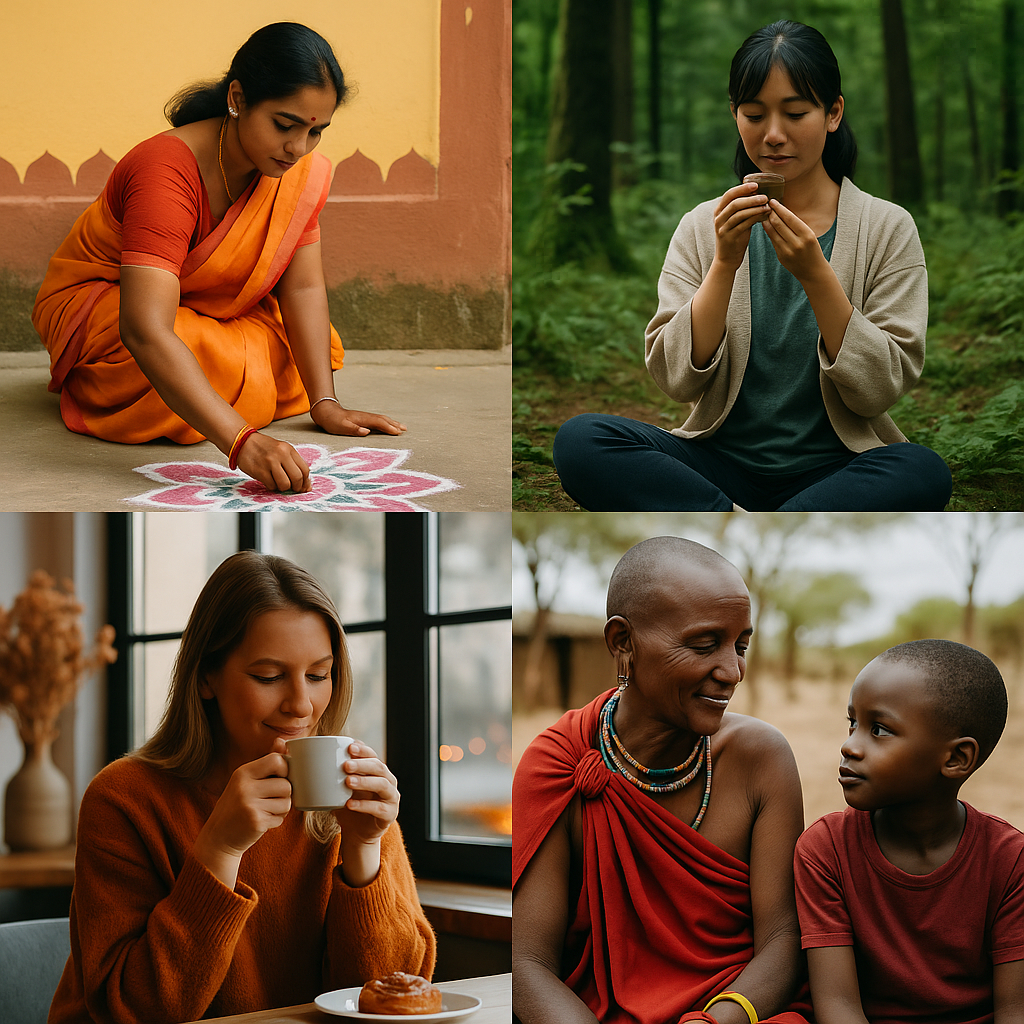
How Different Cultures Slow Down, Find Presence, and Live Intentionally
In a world where we constantly rush from one task to another, mindfulness often feels like something we need to create. But the truth is—cultures around the world have been practicing mindfulness for centuries, long before the word became popular on wellness blogs or meditation apps.
These traditions weren’t designed for productivity or self-improvement. They were simply ways of living: being present, honoring the moment, paying attention, and feeling connected to life.
So today, let’s take a mindful journey across continents and explore how different cultures practice presence, calm, and stillness—without forcing it.
1. Japan – Shinrin-Yoku & The Peace of Simple Moments
Shinrin-Yoku, or forest bathing, began in Japan in the 1980s—but the idea is much older and rooted in everyday life. It’s not hiking, exercising, or photographing nature. It’s simply being among trees. Walking slowly. Feeling the breeze. Listening to leaves. Smelling earth after rain.
Why it works:
- It lowers heart rate and cortisol (stress hormone).
- It improves sleep, creativity, and emotional balance.
- And most importantly—it teaches us that nature doesn’t rush, but everything still gets done.
Other mindful Japanese traditions include:
- Chanoyu (Tea Ceremony): A simple cup of tea, prepared with absolute attention and grace.
- Ikigai: Finding meaning in the little things that make waking up worthwhile.
- Wabi-sabi: Appreciating beauty in imperfections.
The essence? Life doesn’t need to be perfect. It just needs to be noticed.
2. Sweden – Fika: The Art of Pausing for Coffee & Connection
In Swedish culture, “fika” is more than a coffee break. It’s a daily ritual of slowing down—alone or with others—to enjoy coffee, pastries, and conversation without hurry.
It’s not multitasking. You’re not sipping coffee while answering emails. You are just there, present with your drink, your thoughts, or your company.
Fika reminds us:
☕ Productivity isn’t the opposite of rest.
☕ Pausing is not a waste of time—it’s part of time.
☕ Presence is not found in doing more, but in doing what we’re doing with full attention.
3. Hawaii – Ho‘oponopono: Healing Through Honesty and Letting Go
Ho‘oponopono is a traditional Hawaiian practice of forgiveness, reconciliation, and emotional cleansing.
The core idea? Peace begins when we take responsibility for our thoughts, emotions, and relationships.
Instead of holding resentment silently, families would gather and speak openly:
- What hurt me.
- What I wish you knew.
- What I’m willing to let go.
Four key phrases guide this practice:
I’m sorry.
Please forgive me.
Thank you.
I love you.
Simple words. Deep healing. Because mindfulness isn’t just about breathing—it’s about acknowledging what the heart holds.
4. New Zealand – Māori Practice of Whakatā: Rest as Respect
The Māori people of New Zealand use the word “whakatā” to express rest, reset, and breathe.
Unlike modern cultures that glorify exhaustion, Māori tradition sees rest as a form of respect—for the body, land, and spirit.
They pause:
- When emotions become heavy.
- When the ocean is rough.
- Before making big decisions.
Mindfulness here isn’t a technique. It’s an attitude: “I will pause because I belong to the earth—not to my schedule.”
5. China – Cha Dao: The Way of Tea
Across Chinese culture, tea isn’t just a drink—it’s a moment of quiet ceremony.
Cha Dao, or The Way of Tea, teaches:
- Boil the water slowly—don’t rush it.
- Pour carefully—notice the sound.
- Drink fully—let the warmth be a reminder that you are alive.
In tea, there is no achievement. No productivity. Just presence.
Ancient Chinese philosophy also emphasizes:
- Wu Wei – Effortless action, or “doing less while achieving more.”
- Jing – Quietude. A still mind, even in chaos.
- Qi – Life energy, strengthened by breath, posture, and awareness.
6. Denmark – Hygge: Cozy Living as a Form of Mindfulness
Hygge (pronounced “hoo-gah”) is the Danish idea of finding comfort and warmth in simplicity.
It’s not candles and blankets for Instagram aesthetics—it’s:
- Taking joy in a simple meal with close friends.
- Reading a book while wrapped in a soft throw.
- Watching the rain with a warm drink in hand.
Hygge isn’t an escape from life. It’s saying: life is happening right now, and this small moment is enough.
7. Middle East – The Slow Ritual of Arabic Coffee & Hospitality
In many Middle Eastern cultures, serving coffee is an act of connection.
The host prepares it slowly—cardamom, cinnamon, freshly ground beans. Guests sit together, phones away, and simply be.
There’s silence. There’s warmth. There’s no rush.
It’s a mindful tradition of:
- Slowing down.
- Treating visitors with kindness.
- Listening more than talking.
8. Italy – La Dolce Far Niente: The Sweetness of Doing Nothing
Italians have a phrase that translates to “the sweetness of doing nothing.”
It doesn’t mean laziness or procrastination. It means allowing yourself to exist—for no reason, without guilt.
Examples of dolce far niente:
- Sitting in a piazza and people-watching.
- Savoring gelato slowly.
- Laughing with friends with no agenda.
We don’t always have to earn rest. Sometimes, being alive is enough reason to enjoy it.
9. Buddhist Monasteries – Mindful Bells in Everyday Life (Secular Adaptation)
In some Buddhist traditions, whenever a temple bell rings, monks pause—no matter what they’re doing—and take one conscious breath.
This is known as the Bell of Mindfulness.
You can bring this into everyday life by choosing your own bell:
- A message notification.
- A red traffic light.
- A kettle boiling.
- A phone ringing.
Instead of reacting—pause. Breathe. Return.
10. Indigenous Tribes – Storytelling as Presence
Indigenous cultures across the world—from Africa to North America to Australia—practice oral storytelling.
Evenings aren’t spent watching screens but sitting around a fire, sharing stories passed through generations.
This isn’t entertainment. It’s:
- Listening without interruption.
- Being present with memory and emotion.
- Honoring those before us.
Storytelling teaches mindfulness through attention.
To listen is to love.
11. India – Mindfulness in Everyday Rituals & Slowness in Simplicity
Mindfulness in India isn’t only found in temples or spiritual practices—it’s quietly woven into everyday life in simple, human ways.
Chai Time – A Pause in the Middle of Chaos
For many Indian households, early mornings and late afternoons begin with a slow ritual—making chai.
It’s not just about tea. It’s about:
- Letting the water simmer instead of rushing it
- Watching milk rise as the stove crackles
- Smelling ginger, cardamom, or lemongrass
- Standing still, hands wrapped around a warm cup
In a country that’s always buzzing, chai time becomes a small, unspoken meditation.
🌱 What We Can Learn from These Traditions
Mindfulness doesn’t belong to one culture or one method. It’s universal. It shows up when we:
✔ Slow down
✔ Pay attention
✔ Honor ordinary moments
✔ Treat rest and presence as essential—not optional
You don’t need to adopt rituals from every culture. But you can borrow their wisdom.
Across continents, languages, and lifestyles, one truth keeps appearing:
Being mindful isn’t a trend. It’s human.
It’s the way our ancestors lived before alarms, deadlines, and endless notifications.
It’s in a cup of tea, a quiet walk, a handwritten “thank you,” a sunset you don’t photograph—just watch.
You don’t need to meditate for an hour.
You don’t need perfect silence or perfect discipline.
You just need to notice what’s here, while it’s here.
That’s mindfulness.
That’s life—fully lived.